Why Your AI Project Needs a Brain
AI tools can do remarkable work, but they do not automatically preserve everything a project has learned. Here is how to build useful project memory around them.
13 min read
Your AI project needs a brain: a small, maintained system that carries the decisions, knowledge, rules, active work, useful experience, and review practices that matter from one task to the next.
The model provides general capability. The project brain helps it apply that capability consistently to your work. It is not a literal brain, one database, or an unlimited conversation history. The more precise term for much of it is project memory.
This matters whether you use ChatGPT, Claude, Codex, Claude Code, or another agentic tool to research a market, design a website, build a product, prepare a proposal, or run an operation. These tools can inspect material, make plans, use software, and produce real work. But unless the relevant project knowledge is deliberately available, tomorrow’s task can begin as if yesterday’s decisions never happened.
The problem appears in many kinds of work
Imagine using an AI system to design and build a website. During the work, you decide who the site is for, which pages it needs, how it should feel, what language to avoid, and which technical constraints are non-negotiable. You reject several directions and explain why. The AI eventually produces something that fits.
A week later, you ask it to add a page. If the task does not include the relevant decisions, the system may introduce a different tone, repeat an idea you rejected, or overlook an important rule.
The same pattern appears elsewhere:
A research assistant repeats work because it cannot find an earlier conclusion.
A product agent proposes a feature that conflicts with an agreed strategy.
A coding agent changes a system without understanding why it was designed that way.
A proposal assistant uses an old description of the organisation.
An operations agent follows a previous process after the process has changed.
In each case, the AI may be capable of the immediate task. What is missing is continuity between tasks.
Three things we often confuse
It helps to separate three kinds of knowledge.
What the model generally knows
An AI model learns broad patterns during training. That is why it can write, explain concepts, or work with common software and business problems.
That general knowledge does not include the latest state of your project unless you provide it. A model may understand how websites are normally designed, but it does not automatically know the decisions behind yours.
What the AI can see right now
The material available during a task is usually called its context. It can include a request, conversation, attached documents, project files, instructions, search results, and tool output.
Every system has a limit to how much context it can consider at once. Larger limits help, but they do not remove the need to choose the right information. Research on long-context models found that the position of relevant information could materially affect retrieval and use; the lesson is not that every current model fails in the same way, but that fitting information into a conversation is different from using it reliably.[1]
What the project preserves
Project memory is the information deliberately kept so that future work can continue from what has already been established. It can include:
Current goals and requirements.
Important decisions and why they were made.
Working rules and quality standards.
Shared definitions and terminology.
The state of active work.
Useful examples and corrections from earlier tasks.
Sources that support important claims.
These layers work together, but they are not interchangeable. A more capable model does not remove the need for project knowledge, and a long conversation is not automatically a reliable record of the truth.
Why a longer conversation does not solve everything
Keeping one conversation open is the simplest way to help an AI remember. It is useful for a limited, coherent piece of work.
The difficulty begins when the context becomes a history rather than a working brief. Conversations contain good decisions, but also questions, misunderstandings, rejected ideas, repeated instructions, and assumptions that were later corrected. The AI must still decide which parts matter now.
Longer context can also make work slower, more expensive, and harder to inspect. Old and new documents may contradict one another without clearly saying which is current. Anthropic describes context engineering as the broader practice of selecting and maintaining the instructions, tools, examples, history, and knowledge that best support the current task.[2]
In simple terms, the aim is not to show the AI everything. It is to show it the right things at the right time.
What a useful project memory contains
A project memory does not need to be one large system. It is better understood as a few coordinated parts.
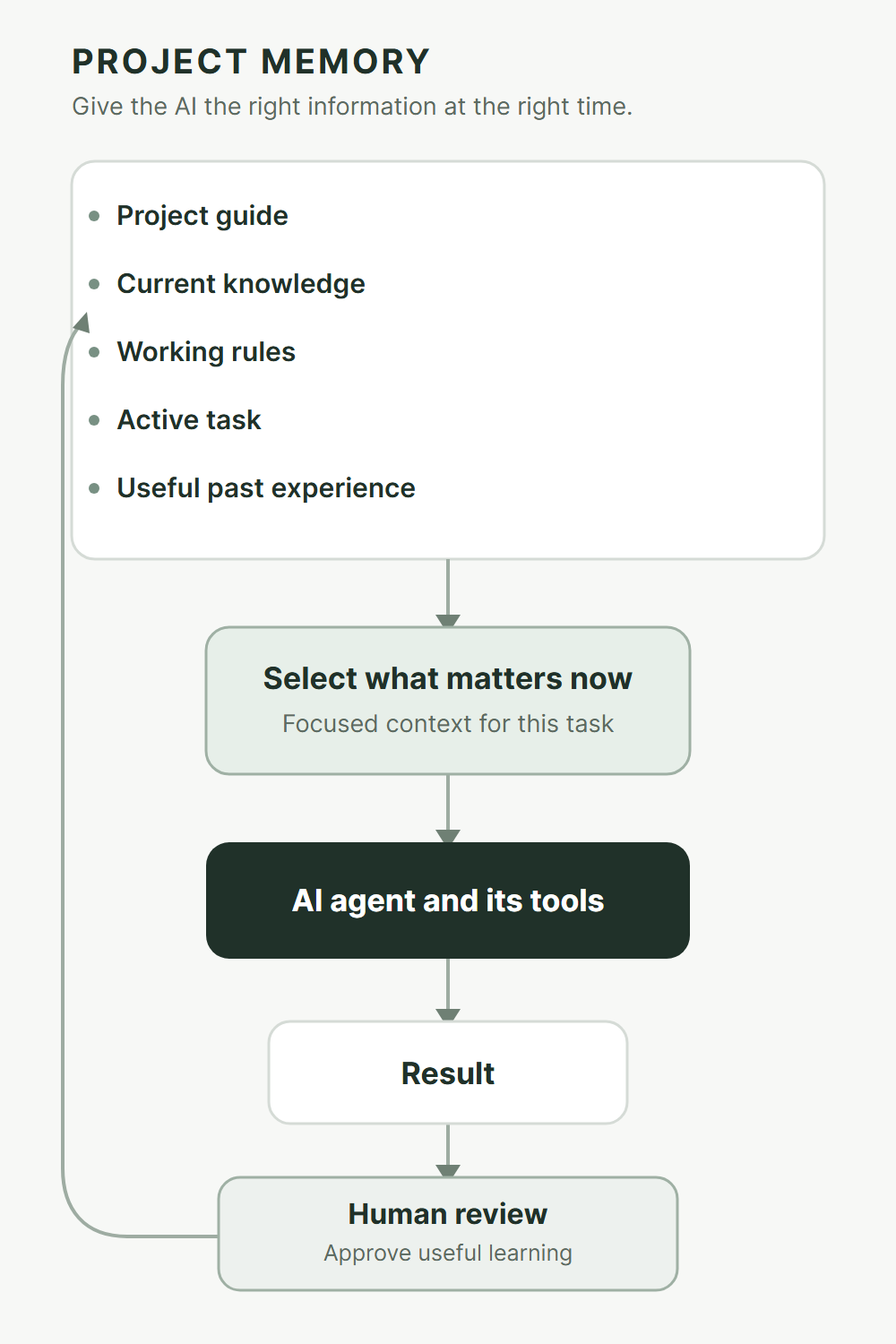
A clear starting point
The AI needs a short introduction to the project: what it is, who it serves, what stage it has reached, and where different kinds of information can be found. This is an orientation guide, not a complete history.
Current sources of truth
Important subjects should have an identifiable current source. A product may have one place for requirements, a business an approved company description, a website documented design rules, and a research project a reviewed record of findings and sources.
The format matters less than the authority. The system needs a way to distinguish an approved decision from an abandoned proposal.
Instructions for doing the work
Project knowledge explains what is true. Instructions explain how work should be done: writing style, review steps, security limits, design standards, coding conventions, and actions that need human approval. GitHub, for example, supports repository-level instructions for Copilot; comparable systems offer persistent instructions, skills, or rules.[3]
The state of active work
Longer tasks need a record of what is being attempted, what is complete, what remains unresolved, and what should happen next. This is temporary state, not permanent knowledge.
Selected experience
Past work can provide useful examples: an approach that failed, a phrase customers repeatedly misunderstood, or a sequence that worked well. Research frameworks often call facts semantic memory, experience episodic memory, and instructions procedural memory. The terms are useful distinctions, but a project does not need a complex architecture to act on them.[4]
Facts, instructions, active work, and experience should not all be stored and updated in the same way.
What several agent platforms are doing
Platforms use different names, but several distinguish conversation history from longer-lived knowledge and task state. OpenAI’s Agents SDK provides sessions to maintain conversation history across agent runs.[5] LangGraph distinguishes thread-scoped memory from longer-term memory available across conversations.[6] AutoGen describes memory components that retrieve relevant information and add it to an agent’s immediate context.[7]
These examples are not a product recommendation. They show that dependable memory is not being treated as one model feature. It is a separate part of how agent systems are designed.
For a non-technical team, that may mean maintained project documents and clear instructions. For a technical team, it may also include retrieval, task state, access controls, evaluation, and governed memory updates. The underlying need is the same.
Common approaches—and their limits
Keep the conversation
Useful for short, coherent work. Its weakness is that it preserves everything that was said rather than what remains important.
Save summaries
People or AI can summarise work at useful points. Summaries reduce volume and help a new session start, but they can omit a detail or preserve a mistaken interpretation. Important summaries need review.
Maintain project instructions and documents
A small set of current documents can preserve goals, standards, decisions, and terminology in a form that people and AI can inspect. This is usually the best place to begin. It succeeds only when someone owns the material and keeps it current.
Search the project’s knowledge
When there is too much material to load at once, a system can search for the relevant parts. One widely used approach is retrieval-augmented generation, or RAG: the system retrieves material from an external collection and supplies it for the current task.[8]
Retrieval is useful, but finding something similar is not the same as finding something correct. A system should consider the source, date, status, and authority of what it retrieves.
Learn from previous attempts
An agent can retain selected lessons or examples from past work. Reflexion studied written reflections from earlier attempts, while Generative Agents explored a combination of stored experience, reflection, retrieval, and planning.[9][10]
This is promising, but an AI can learn the wrong lesson. Automatically remembering every conclusion can make a system confidently repeat its own mistakes.
Combine layers when the work requires it
Long-running systems may keep recent work close at hand and retrieve older knowledge only when needed. MemGPT explored a tiered design inspired by how computers move information between memory layers.[11]
This can handle more complex work, but it also needs more oversight. Start with a demonstrated continuity problem, not a desire to build elaborate infrastructure.
What has worked for me
The most dependable shift in my own work has been to stop treating conversation history as the project’s source of truth. I separate what the project currently knows, how work should be done, what is happening in the active task, and which earlier experience may help.
A repeated correction should become a maintained rule, example, or check—not remain buried in a conversation. For example, when a design decision keeps being re-explained, documenting the rule and checking it during review is more reliable than asking an AI to remember a previous discussion.
I also prefer a short guide that tells the AI where to look over one enormous instruction set that tries to explain everything. These are practical observations, not universal research findings. The right design depends on the work, its risks, and how often it changes.
How to begin without overengineering
1. Identify what keeps being lost
Look for repeated explanations, recurring mistakes, contradictory outputs, rediscovered research, and tasks that are difficult to resume.
2. Create a short project guide
Explain the purpose of the project, its present stage, its main constraints, and where current information lives. Keep it short enough to remain useful.
3. Establish sources of truth
Decide where approved requirements, decisions, terminology, and working standards belong. Avoid keeping several apparently current versions of the same information.
4. Separate current knowledge from history
Preserve the latest decision as the source of truth. Keep previous discussion only when its history remains useful.
5. Retrieve information when it is needed
Do not load the entire project into every task. Start with predictable folders, filenames, links, and indexes. Add more advanced retrieval only when the volume of material justifies it.
6. Review what becomes permanent
An AI can suggest a lesson, decision, or update. Important changes should be reviewed before becoming durable project knowledge.
7. Measure whether it helps
Track whether people repeat the same corrections, similar tasks stay consistent, the right source is retrieved, interrupted work resumes successfully, and old information continues to influence new work. Memory is valuable only when it improves the work.
A simple first-week setup
You can test this approach without buying a new platform or rebuilding your tools.
Create one short project guide. It should say what the work is trying to achieve, who the result is for, what is in and out of scope, and where the current requirements and decisions live. Then create one decision record for the few choices that would be expensive to reverse.
For each decision, record the choice, the reason, the owner, and the date. A sentence or two is usually enough. The aim is not bureaucratic documentation. It is to prevent an old idea, an early draft, or an AI-generated suggestion from quietly becoming the project’s truth.
At the end of a meaningful task, write a short handover: what changed, what remains open, which source was updated, and what the next task should check. Ask the AI to propose that handover, but review it before treating it as durable knowledge.
This small routine also clarifies responsibility. People remain accountable for decisions and accuracy. The AI helps find, apply, and summarise the information. It should not be the only system allowed to decide what the project remembers.
If the project handles private, commercial, legal, health, or personal information, define the boundary before connecting documents or tools. Decide what may be stored, who may retrieve it, how long it remains available, and how it can be corrected or removed. More memory creates more responsibility.
Treat access as part of the design, not a later administrative task. A useful project brain should help the right people and systems find approved knowledge without quietly exposing information that was never meant to travel beyond its original context.
Recommendations for leaders
Start with the work, not the technology
Do not begin by buying a memory platform or creating a large database. Begin with the moments where continuity breaks.
Give each important subject an owner
Someone should decide what is current, correct it, and remove what is no longer valid.
Keep knowledge understandable to people
If only the AI can interpret the memory system, it will be difficult to review and trust. Important knowledge should remain inspectable.
Do not confuse relevance with authority
A search system may find a relevant document that is outdated or unapproved. Preserve where knowledge came from and whether it is current.
Make uncertainty visible
Not every project question has a settled answer. Mark assumptions, unresolved choices, and material gaps clearly instead of allowing them to look like established facts. This helps people review the work and gives the AI a safer basis for asking for clarification rather than inventing certainty.
Design a way to forget
Projects change. A useful memory system supports correction, expiration, replacement, and deletion.
Turn critical rules into controls
If a requirement is essential, do not rely entirely on the AI remembering a sentence. Reinforce it through templates, permissions, review steps, automated checks, or tests.
Begin small
For many projects, a clear guide, maintained sources of truth, and disciplined task summaries will provide most of the initial value. More complex infrastructure should solve a demonstrated problem.
The goal is not to remember everything
A useful project brain does not attempt to give an AI every piece of available information. It helps answer more important questions: What are we trying to achieve? What has already been decided? Which information should be trusted? What changed? What matters now? What should be carried forward? What should be forgotten?
The most dependable AI projects will not necessarily have the largest models or the longest conversations. Their project brains will be defined by how carefully they manage knowledge, attention, authority, learning, and change.
References
- (2024). Lost in the Middle: How Language Models Use Long Contexts. Transactions of the Association for Computational Linguistics. DOI: 10.1162/tacl_a_00638. ↩
- (2025-09-29). Effective context engineering for AI agents. Anthropic Engineering. ↩
- (2026). Customizing Copilot for your project. GitHub Docs. ↩
- (2023). Cognitive Architectures for Language Agents. arXiv. ↩
- (2026). Sessions. OpenAI Agents SDK documentation. ↩
- (2026). Memory overview. LangGraph documentation. ↩
- (2026). Memory and RAG. AutoGen documentation. ↩
- (2020). Retrieval-Augmented Generation for Knowledge-Intensive NLP Tasks. NeurIPS. ↩
- (2023). Reflexion: Language Agents with Verbal Reinforcement Learning. NeurIPS. ↩
- (2023). Generative Agents: Interactive Simulacra of Human Behavior. ACM UIST. ↩
- (2023). MemGPT: Towards LLMs as Operating Systems. arXiv. ↩